M.L. Sebastian is now br8n.

AI Capability Installation

AI capability installation, explained

Tools, workflow, people, and governance built as one operating capability — from your own files. Your team runs it. Your organization owns it.

The category

A running capability, not a recommendation.

AI capability installation is the practice of building AI into work an organization already does — from the organization’s own files, decisions, and processes — and then transferring ownership, so the team runs it without the vendor when the engagement ends.

That places it between two familiar offers: consulting, which advises and leaves you to build, and implementation, which builds and leaves you to run.

A report tells you what to build. An installation leaves the capability running, in your hands.

The full answer

How is AI capability installation different from AI consulting?

AI adoption consulting sells judgment: an assessment of where AI fits your business, a roadmap, usually some training. It can be exactly right and still change nothing, because the model ends where your capacity begins. You get the slides. You still have to do the building, and most teams that had spare building capacity would not have hired a consultant.

Installation keeps the diagnosis but moves the finish line. The engagement does not end when the recommendation is delivered; it ends when the recommended thing is running inside your operation, staffed by your people, documented in your files. A consultant leaves you knowing what to do. An installer leaves you already doing it.

Neither is wrong. They answer different questions. Advice is the right purchase when execution capacity already exists in the building. It usually does not, which is why so many AI strategy documents are current, correct, and unused.


How is it different from an AI implementation project?

An AI implementation project builds something real: a chatbot, an automation, an integration. The builder arrives with a stack and templates, deploys, and moves to the next client. The system works on handover day. The open question is what happens after — who tunes it when the process changes, who understands why it answers the way it does, what happens when the person who championed it moves on.

The difference with installation starts with the raw material. An implementation is built mostly from the builder’s stack; an installation is built from your files — how the work gets done here, the decisions already made, the exceptions that make your business yours. That written context is what makes the result specific to you rather than a template with your logo on it. The discipline behind that layer is context engineering.

The second difference is who can run it. Installation treats training your operators and writing the governance as build work, not aftercare, because a system only your vendor understands is a dependency, not a capability.

Which one do we actually need?

A short test: name what you want to be true ninety days after the engagement ends.

  • If the answer is we know what to do, buy adoption consulting. You need judgment, and you have hands.
  • If the answer is a specific system exists, buy an implementation project. You need the build, and you accept depending on the builder for changes.
  • If the answer is our team runs this without anyone’s permission, that is capability installation. Built from your files, owned by you, run with you until your people run it alone.

The observation underneath this page: the deliverable that matters is what your team still runs after the last invoice. Every other difference between these three offers follows from that one. And if you already bought AI and it went quiet, that is a different diagnosis — why AI rollouts stall covers it.

What does it cost, and where do you start?

br8n publishes its numbers at the individual scale. The Working Intelligence Audit — the diagnostic that maps where your knowledge lives and which process to build on first — runs $397 to $997: $397 self-guided, $497 with a written review, $997 run live with Michael. A Personal Brain build is $1,497, or $4,997 for the deep version. Company installs start at $15,000 plus a retainer and run two to six months, priced after a diagnostic, because the honest number depends on how many workflows and people the capability has to reach.

The audit is the deliberate first step at any scale. It is bounded, it has a fixed price, and it produces the map — where knowledge lives, what repeats, what to build first — that any of the three paths above would need anyway. You keep the map either way, whoever you hire next, including nobody.

The method

Four layers move together.

  1. Map

    See the real work

    Locate the knowledge, repetition, handoffs, risk, and first process worth changing.

  2. Build

    Build inside it

    Connect your source material and AI tools to the workflow people already use.

  3. Transfer

    Run, govern, own

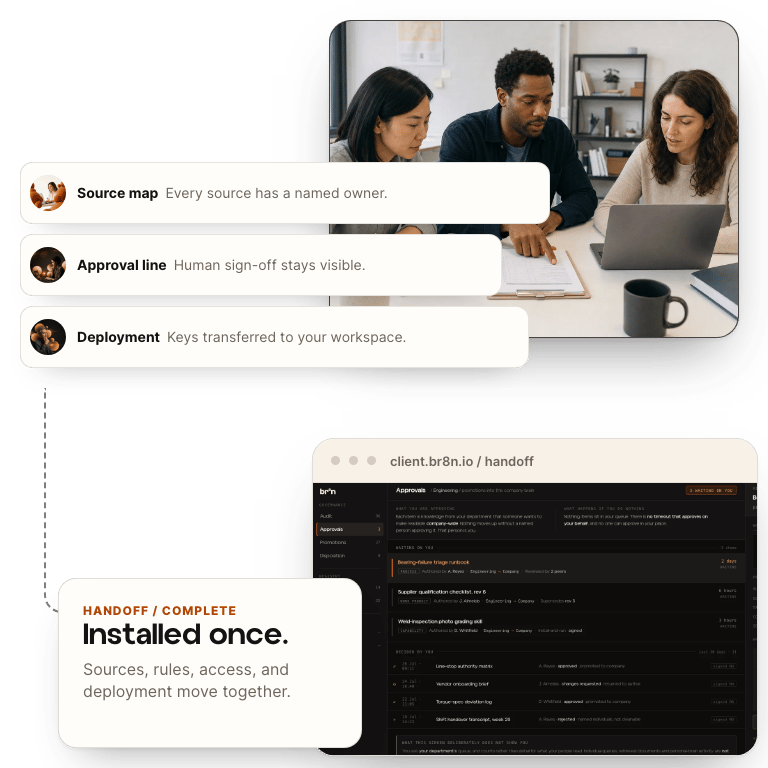
    Train the operators, document the boundaries, prove the work, and hand over the system.

Three offers, one table

Same topic. Different finish line.

CompareAI adoption consultingAI implementation projectCapability installation
What you getAdvice and trainingA system they buildA capability built from your files
Who executesYou, after they leaveThey build, then leaveBuilt with you, run with you
Built fromFrameworks and best practiceThe builder’s stack and templatesYour decisions, files, and workflows
Ninety days laterA plan, if you built itA system only the builder can changeYour team runs it; you own it

The operating test

The technology worked. Did the work change?

Pilots stall when the model succeeds but the surrounding operation stays the same. Installation treats adoption and governance as build work. See the rules in Trust and Security, or the knowledge layer in context engineering.

  • Operators can run the capability without the installer.
  • Source material and access boundaries are documented.
  • Models can change without rebuilding the operation.

Make the capability yours

Find the first build point.

The audit maps your knowledge, your repetition, and the first process worth changing — for a fixed price. You keep the map either way.

FAQs

What is AI capability installation?

The practice of building AI capability inside an organization — into its existing workflows, its people, and its governance — so the organization runs it without the vendor after the engagement ends. The deliverable is not a report or a tool. It is an operation that works differently and owns the difference.

How is AI capability installation different from AI consulting?

Consulting diagnoses and recommends; you still have to build what the slides describe. Installation does the build inside your operation, runs it with your team, and transfers ownership before leaving. A consultant leaves you knowing what to do. An installer leaves you already doing it.

How is it different from an AI implementation or integration project?

Implementation deploys software. Installation treats the tool as one layer of four: the tool, the workflow it lives in, the people who run it, and the governance around it. Skip the other layers and a pilot often stalls when its champion leaves.

AI adoption consultant vs AI implementation partner: which should we hire?

Hire an adoption consultant when you need direction and training and have the capacity to execute. Hire an implementation partner when you need a specific system built and can live with depending on the builder. If you need the capability owned and run by your own team, that is a third category: capability installation.

Do we need an AI team before an installation?

No. The engagement is how the team capability gets built. Existing operators learn to run the system as it goes into work they already do, keeping the capability inside the operation instead of in a lab beside it.

What does an AI capability installation cost?

At the individual scale, br8n publishes its numbers: a Working Intelligence Audit runs $397 to $997 (self-guided course $397, with a written review $497, live with Michael $997) and a Personal Brain build runs $1,497 to $4,997. Company installs start at $15,000 plus a retainer and run two to six months, priced after a diagnostic because the honest number depends on how many workflows and people the capability has to reach.

Which AI vendor does an installation lock us into?

None, if it is done right. The capability is structured to be portable across model vendors, with source material in open formats, retrieval over open protocols, and governance that names vendors as replaceable parts. When a better model ships, you swap the engine rather than the operation.

What do we own when the installer leaves?

Everything the operation needs to keep running: the brains and source files, workflow integrations, governance documents, and the trained habits of the people who run it. br8n keeps its delivery engine, the internal tooling and methods used to perform the work.

Can't find what you're looking for? Talk with us