
How to Think About AI in Your Business
The operator’s foundations. Not theory: every lesson ends in something you do. You leave with a written baseline, your own operating rules, five moat scores, and your first real delegation.

Free entry course · certificate on completion
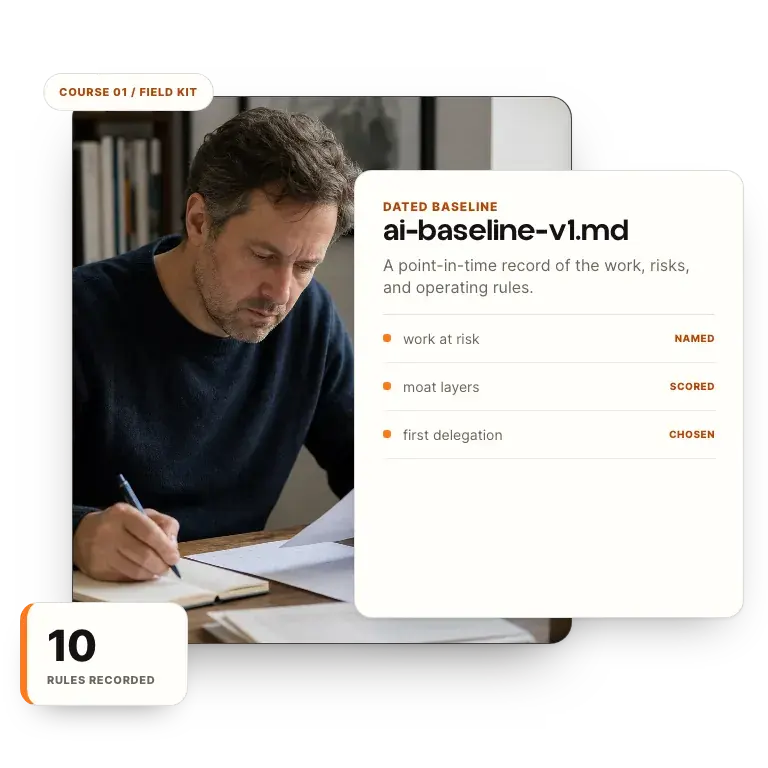
You leave holding work.
- Write a dated AI baseline for your business: which deliverables are at risk, what your role really is, and what survives the export test
- Draft your own ten operating rules — and isolate the three that are uniquely yours to enforce
- Score your business across the five durable moat layers and see where your defensibility actually sits
- Spec your first delegation and run it on a real task, then read the result like an operator
- AI baseline
- Operating rules
- Moat scoring
- Delegation basics
There are 4 modules in this course.
4 modules · each ends in a worksheet your answers save to · Last verified 2026-06-17.
01.1Where You Actually Are
Most operators reach for AI before they know what hurts. That gets you a clever demo and zero change to your Tuesday. So we go backward: name the five things that actually cost you, in real hours, before you touch a tool. The leverage map isn't homework — it's the diagnosis the whole course treats. One caveat matters more than any feature list: if you've ever thought 'I'm not a tech person,' that sentence is the only real blocker in your way, and we break it in this session by having you produce one usable output from your own business before you learn a single concept. You're not learning AI. You're auditing where it would move a number you can see. Meet Dana — she runs a 4-person brand & marketing studio: she does client creative and ops herself, with two designers and a part-time project coordinator, and the studio ships real recurring deliverables every week. This module carries the FULL worked install below, every step shown — Dana from 'I'm not a tech person' to a ranked map of HER studio plus one real, rated, redirected output (the weekly client status update she writes by hand) in one sitting. Later modules will strip the earliest steps so you do more of it unaided; here, nothing is hidden.
- You will produce a ranked top-5 leverage map of YOUR business, each item tagged with minutes-per-instance × times-per-week = hours/week, totaled.
- You will run your single most repetitive task through AI once, in your real account, and rate the first output 1-4 against what you'd actually send a client.
- You will write, in one sentence, the identity you walk in with ('I'm not a tech person' / 'I already use it daily' / something else) and what would have to be true to change it.
Do thisOpen a blank doc titled '[Your Business] — Leverage Map' (Dana's reads 'Dana's Studio — Leverage Map'). List the 5 tasks that eat the most of your week. For each: minutes-per-instance × times-per-week = hours/week, plus one line on what 'good' looks like when YOU do it — for Dana, rows like 'weekly client status updates,' 'design-feedback rounds,' 'new-project scoping briefs,' 'invoicing/ops admin,' 'social captions for client accounts,' each in her real terms. Total the five. Then take the single most repetitive one — Dana's weekly client status update — paste it into Claude or ChatGPT with the Task Triage prompt, rate the first output 1-4 against your own standard, and write the one-line reason. Save the doc and the rated output as a pair — that pair IS your gate artifact.
01.2Your Operating Rules
Rules sound like bureaucracy until the day AI confidently invents a client's number and you almost send it. The rules don't slow you down — they decide, in advance, where your judgment stays in the loop and where it doesn't have to. Two rules earn their place immediately: match the model to the task (Dana's routine social caption draft for a client account does not need her most expensive model, and learning that now saves her studio real money every week), and name what AI never touches. You direct the tool; the tool does not direct you. This module makes that concrete by having you catch your own AI in a violation and fix it, so the rule is something you've enforced once, not something you read.
- You will write 5-7 plain-language rules governing how AI touches your real work — what it drafts, what you always verify, what it never sees, and which model handles which job.
- You will assign the right model + cost tier to each of your top-5 tasks, so you stop burning a frontier model on work a cheaper one handles.
- You will redirect one AI output that broke a rule — the bad result, the rule it violated, the corrected second pass.
Do thisDraft your Operating Rules doc with the Rule-Drafting prompt — four columns: task → which model → what AI drafts vs. what you verify → what data it must never receive (client PII, signed contracts, anything under NDA). Run it against the five tasks already on your leverage map. Dana sorts her studio's rows: social captions → cheaper tier, AI drafts, she verifies brand voice; client status updates → cheaper tier, AI drafts, she verifies every figure; scoping briefs → stronger tier, client-facing; and she marks signed client contracts as never-touch. Then deliberately feed AI a task with a missing constraint — Dana asks it to write a status update that states a client's remaining budget she never gave it — watch it produce something you'd never ship, name the rule that catches it, and run it again corrected. Submit the rules doc plus that before/after pair.
01.3Where Your Moat Is
When AI makes the generic version of your work free, the generic version stops being worth money. That's not a threat — it's a sorting line. Everything copyable depreciates; everything specifically YOU appreciates. Your moat is the context no model ships with: how you actually decide, who you actually serve, what 'good' means in your shop. For Dana, that's how her studio prices a brand sprint, which clients she'd turn down, and the line she'd never put in a client caption. The mistake is leaving that locked in your head, where it can't compound and isn't portable when you change tools. So you START writing it down as a file you own — a first page, not a finished brain. (Building that file into a full portable brain is Course 5's whole job; here you only prove the principle with one question.) You'll feel the difference the moment a cold answer and a context-loaded one sit side by side.
- You will name the 2-3 things in your business that get HARDER to copy as AI gets cheaper — your judgment, relationships, accumulated context — and write why each survives commoditization.
- You will START a portable context file (plain text/Markdown) capturing operating knowledge that lives only in your head, and prove it works by having AI answer one real business question using only that file.
- You will critique an AI answer that's fluent but wrong-for-you, and document the missing context that made it generic.
Do thisCreate 'context.md' and dump in the standards, preferences, and hard-won rules AI keeps getting wrong about your work — how YOU price, who your buyer actually is, what you'd never say. Dana writes: her studio prices brand sprints as a flat package not hourly, her real buyer is a founder at a transition moment (not a procurement lead), and she'd never promise a turnaround her two designers can't hold. Then ask AI one real question about your business twice: once cold, once with context.md pasted in. Dana asks 'how should my studio quote a 3-week brand refresh?' — cold, AI returns an hourly estimate; with context, it returns her flat-package logic. Save both answers and a 3-line note on what the file changed. That diff is your gate artifact. Keep the file small — one page proves the point; Course 5 makes it a system.
01.4Your New Job Description
The operators who lose to AI keep doing the work it now drafts. The ones who win change their job description: less producing, more directing and judging. That's not a downgrade — directing and evaluating AI well is a harder, higher-value skill than the typing it replaces, and it's the one this whole track installs. By now Dana has the studio's map, the rules, and the first page of the moat file. This module turns them into a sentence about how she spends Monday. You're not finishing a course — you're writing down who you are on the other side of it, and naming, in plain words, what you've handed off and what you've kept.
- You will rewrite your own job in terms of what you now DIRECT and EVALUATE versus what you used to DO by hand, naming which top-5 tasks move to the AI-drafts/you-judge column.
- You will set a personal cadence — what you check daily, what you let run, what 'good enough to ship without me' means — for at least one recurring task.
- You will write a one-line accountability note: who owns each shifted task going forward (you on a lighter cadence, the AI, or a delegate).
Do thisWrite 'My New Job Description' in two columns: 'Used to do by hand' → 'Now direct and evaluate.' Move every top-5 task to its correct side. Dana moves social captions and the weekly client status update into 'direct and evaluate,' keeps scoping briefs and final design sign-off in 'do by hand.' For the most-ready one — her weekly client status update — write the cadence ('AI drafts the weekly client update Friday AM; I edit and send by noon') plus who owns it (Dana on a lighter cadence, with her project coordinator pulling the inputs). Submit the two-column doc — it's the through-line from leverage map to rules to moat.

Michael Sebastian
I install AI for operators. The Lab is where the method is taught, and where my clients onboard. This course is that method.
More about me →

The Install Track
Course 01 is free. Start tonight.
This course is $397 on its own, or part of the Install Track. The first course is the open door, and the baseline you write there gets used by every course after it.
Already enrolled? enter the Lab directly.
FAQs
Do I need a technical background?
No. The track is written for operators, not engineers. If you run a business or a role and you’re honest about where you actually are, you have the prerequisites.
How long does this course take?
Lessons are short on purpose — one idea per screen. Most people finish a course in two or three sittings. The worksheets take longer, because they’re real work on your real business. That’s the point.
What does the $497 option add?
Our eyes on your audit. $497 is the Working Intelligence Audit course plus our written review — we read your submissions and send a one-page response: what your scores say, and what to install first. It’s the bridge between self-serve and working with us directly.
Can't find what you're looking for? Talk with us