
Own the Running System
You learned to put an agent to work. This is the part that decides whether it still works in six months: maintaining the harness around it. You leave able to run a recurring Harness Pass on your own setup — and you will have run one, for real, on the system you built.

Lab access is arranged separately
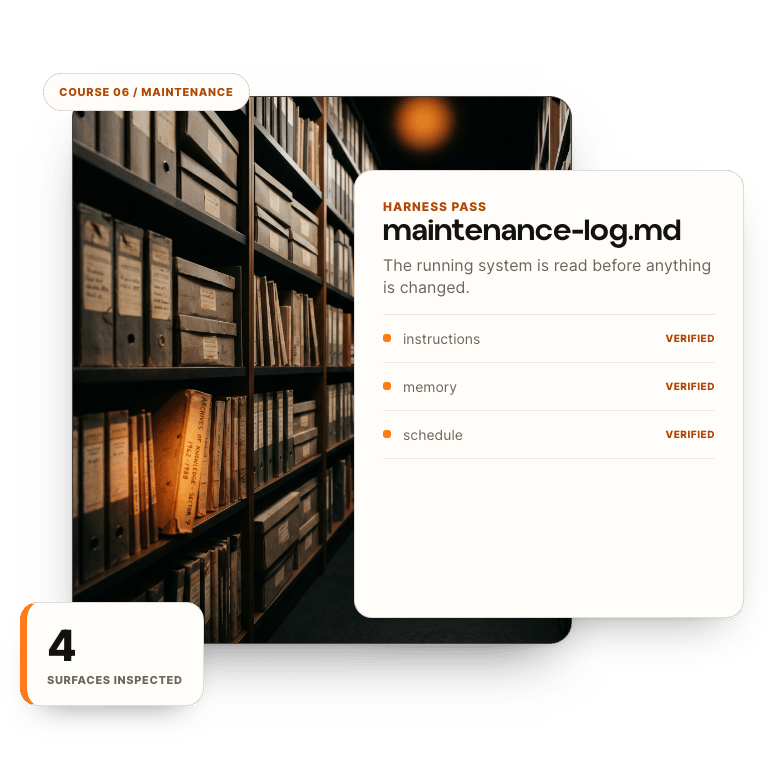
You leave holding work.
- Spot the two drifts: the world moving under your agent, and the model outgrowing the rails you built
- Map your harness into four surfaces and run the five checks to produce evidenced findings
- Decide cut / keep / verify-first — and defend keeping a low-usage item that is armed, not dead
- Install a recurring Harness Pass with a real trigger, logged so the next pass is faster
- Harness maintenance
- Verify-before-cut
- The five checks
- Maintenance cadence
There are 4 modules in this course.
4 modules · each ends in a worksheet your answers save to · Built on the live maintenance pass we ran on our own agent system in June 2026 — including the cut we almost got wrong..
06.1The Two Drifts
<p>This chapter breaks into 5 lessons:</p><ul><li>Launch Is Not the Finish Line</li><li>Agents Break in Both Directions</li><li>Two Drifts, One Diagnosis</li><li>Dana's Job-Status Agent</li><li>It Ran ≠ It's Doing the Job</li></ul>
- You will be able to state, in your own words, why 'it ran this morning' is a weaker claim than 'it's still doing the job' — and name one agent of yours where you've only ever checked the first.
- You will be able to explain why a more capable model can break an agent that was working — and to name one guardrail you wrote for a weaker model that a smarter one might now trip over.
- You will be able to define world-drift and model-drift in one sentence each, and correctly classify a given failure as one or the other.
- You will be able to spot both drifts coexisting in a single agent, and recognize why one of them looks perfectly healthy in the logs.
- You will be able to state the read-the-output-not-the-run rule and apply it to one of your own agents to produce a single evidenced observation.
Do thisPick one agent you run. Write down the last time you checked that it RAN, and the last time you read what it actually PRODUCED. Notice the gap.
06.2Read Your Harness
<p>This chapter breaks into 4 lessons:</p><ul><li>The Four Surfaces</li><li>The Five Checks</li><li>Dana Runs the Checks</li><li>Finding vs Assertion</li></ul>
- You will be able to name all four surfaces of your own harness — Instructions, Memory, Capability, Scheduling.
- You will be able to point to the specific file, store, tool, or trigger that each surface lives in for your setup.
- You will be able to run all five checks — Eats, Reach, Job, Proof, Value — against a single surface.
- You will be able to tell when a check has produced a finding versus when it has cleared the surface.
- You will be able to follow one operator mapping four surfaces and running five checks on one of them.
- You will be able to recognize the moment a check turns into a finding.
- You will be able to tell an evidenced finding from an assertion in your own notes.
- You will be able to rewrite an assertion into a finding by attaching a pointer.
Do thisWrite your harness's four surfaces down, one line each. For every surface, name the actual artifact it lives in — the SOP folder, the memory file or store, the tool list, the trigger schedule.
06.3The Delete Instinct
<p>This chapter breaks into 4 lessons:</p><ul><li>Ask What to Remove</li><li>A Cut Is a Claim</li><li>Dana's Compliance Checklist</li><li>From Our Own Shop: The 31 Skills</li></ul>
- You will be able to state the maintainer's question — what should I remove? — and name one thing in your own harness you've been adding to instead of pruning.
- You will be able to explain why an unpruned harness loses trust.
- You will be able to classify a cut candidate as dead-by-DECISION, dead-by-DATA, or just-quiet.
- You will be able to say why low usage is a prompt to investigate rather than a kill signal.
- You will be able to recognize an armed capability — low usage now, load-bearing for a known future move.
- You will be able to apply the 'what would I lose next month?' test to a cut candidate.
- You will be able to retell the 31-skills story as a worked case of armed-not-dead, and name the actual fix.
- You will be able to decide cut / keep / verify-first on one of your own candidates and write down the missing fact instead of cutting.
Do thisOpen your harness and find one place you've added to in the last month — a new rule, tool, or memory entry. Then ask the maintainer's question of the whole thing: what could come out?
06.4The Maintenance Ritual
<p>This chapter breaks into 5 lessons:</p><ul><li>Afloat, Not Off the Dock</li><li>The Harness Pass: Cadence</li><li>The Harness Pass: The Trigger</li><li>The Maintenance Log</li><li>Telemetry Beats Memory — Then Run the Pass</li></ul>
- You will be able to state, in one sentence, the difference between the launch question and the maintenance question for your own agent setup.
- You will name one thing you've been treating as 'done' that is actually a running bet.
- You will be able to define a Harness Pass and set a concrete cadence floor for your own system.
- You will say why a once-and-done check is not maintenance.
- You will name at least one off-cycle trigger that fires a pass for your own system.
- You will explain why cadence-without-trigger fails on the exact events that break harnesses.
- You will be able to record a finding as a single structured row: surface, finding-with-pointer, decision, verified-by.
- You will state the two jobs the log does that memory can't.
- You will be able to say why a usage tally beats your intuition about what fires, and why the tally is a list to investigate, not a kill list.
- You will run your first real Harness Pass on your own system at the gate.
Do thisName one part of your agent setup you've been calling 'done.' Write the maintenance question for it: not 'did it launch,' but 'is it still doing what I need, and how would I know?'

Michael Sebastian
I install AI for operators. The Lab is where the method is taught, and where my clients onboard. This course is that method.
More about me →

The Install Track
Start with the free course — this one unlocks on the way.
This course is in the Lab catalog but is not currently sold on its own. Start free, or ask us about access.
Already enrolled? enter the Lab directly.
FAQs
Do I need a technical background?
No. The track is written for operators, not engineers. If you run a business or a role and you’re honest about where you actually are, you have the prerequisites.
How long does this course take?
Lessons are short on purpose — one idea per screen. Most people finish a course in two or three sittings. The worksheets take longer, because they’re real work on your real business. That’s the point.
What does the $497 option add?
Our eyes on your audit. $497 is the Working Intelligence Audit course plus our written review — we read your submissions and send a one-page response: what your scores say, and what to install first. It’s the bridge between self-serve and working with us directly.
Can't find what you're looking for? Talk with us